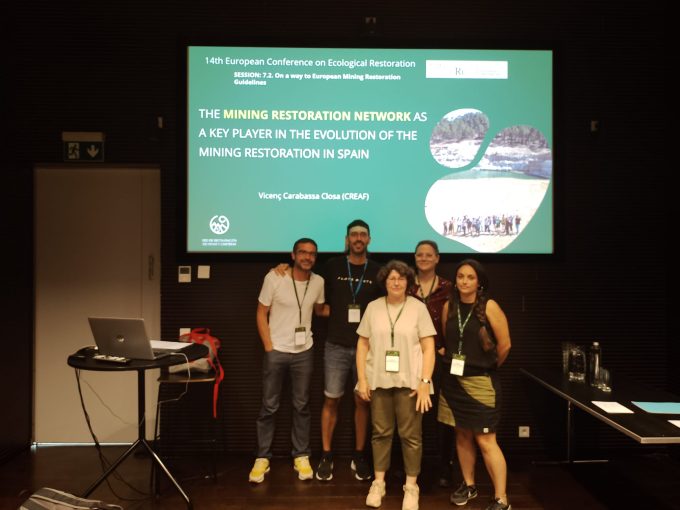
The event, held in Tartu, Estonia, from 26 to 30 August, gave experts the opportunity to present their progress, which attracted the interest of the European Commission
By Carmen Pi
The Mining and Quarry Restoration Network (RMC) took part last week in the 14th European Conference on Ecological Restoration (SERE2024), held from 26 to 30 August in Tartu, Estonia. During the event, the European Commission expressed an interest in learning more about the Network, recognising its potential to play a key role in ecological restoration, particularly in the context of the recent approval of the European Nature Restoration Law.
In the session entitled “On a way to european mining restoration guidelines“, Vicenç Carabassa, a researcher at the Centre for Ecological Research and Forestry Applications (CREAF) and a member of the RMC Network, presented the initiative, highlighting how the Network is “at the forefront of the development of mining restoration in Europe”.
Jordi Cortina-Segarra, professor at the University of Alicante and president of the European Chapter of the Society for Ecological Restoration (SER); Carolina Martínez-Ruiz, Professor of Ecology at the University of Valladolid and leader of the Restormine research group; Daphne López Marcos, PhD in Forest Conservation and Sustainability and researcher in the Restormine group; and Josu González Alday, professor at the University of Lleida and principal researcher at Agrotecnio – Fundació Centre de Recerca en Agrotecnologia, are some of the RMC Network members who took part in the conference, where they presented various papers on their current mining restoration research. The presentations addressed topics such as soil regeneration, vegetation dynamics and restoration strategies adapted to different European ecosystems.
Towards a European Network
“The presentation of the RMC Network at this conference comes at a crucial time”, said Carolina Martínez-Ruiz, in light of the proposal to create a European mining restoration network within the Society for Ecological Restoration (SER) Europe. “The aim of this network is to bring together mine restoration experts and share knowledge, with a view to developing good practice guidelines adapted to the different European ecosystems, from Mediterranean to boreal”, explained Martínez-Ruiz, who recalled that the RMC Network’s experience in Spain can “serve as a model for this effort at continental level”.
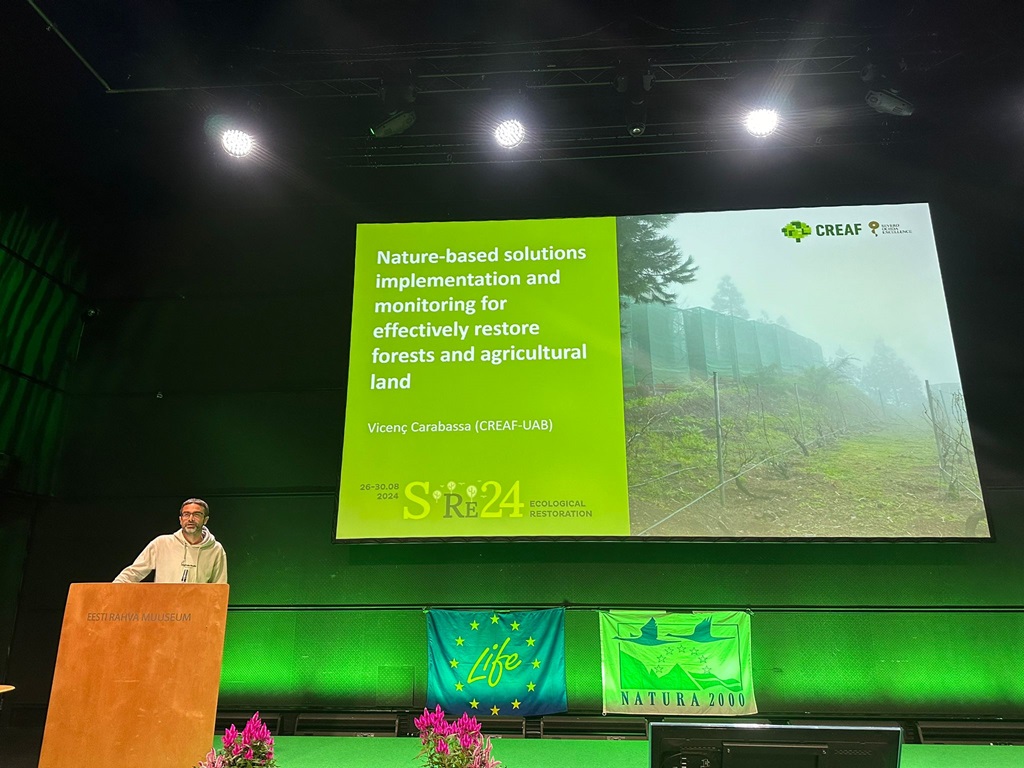
Vicenç Carabassa, during one of his presentations.
“At the RMC Network, we are in a privileged position to lead the ecological restoration movement in mining at European level. With the intention of creating a European network and our own network already up and running, we have the advantage and capacity to take the initiative in this important endeavour”, stressed Vicenç Carabassa, who described the RMC Network presentation session as “a great success”. “Our participation in SERE2024 has enabled us to showcase our work and highlight the importance of collaboration between companies, research centres and public administrations in mining restoration”, emphasised the expert, who also gave the presentation “Implementation and monitoring of nature-based solutions to effectively restore forests and agricultural land”.
In addition to the main session, RMC Network members contributed several key research projects to the conference. Carolina Martínez-Ruiz and Josu González Alday led the presentation entitled “20 Years of Research in Restored Mining Areas in Mediterranean Spain: Insights and Findings“, which reviewed two decades of progress in the restoration of mining areas and presented the national RestoreMine project, funded by the Ministry of Science, Innovation and Universities. “The aim of this project is to develop new strategies to improve restoration in areas affected by mining, providing crucial information on vegetation dynamics and changes in soil on mining slopes, which are essential elements for successful restoration”, explained Martínez-Ruiz.
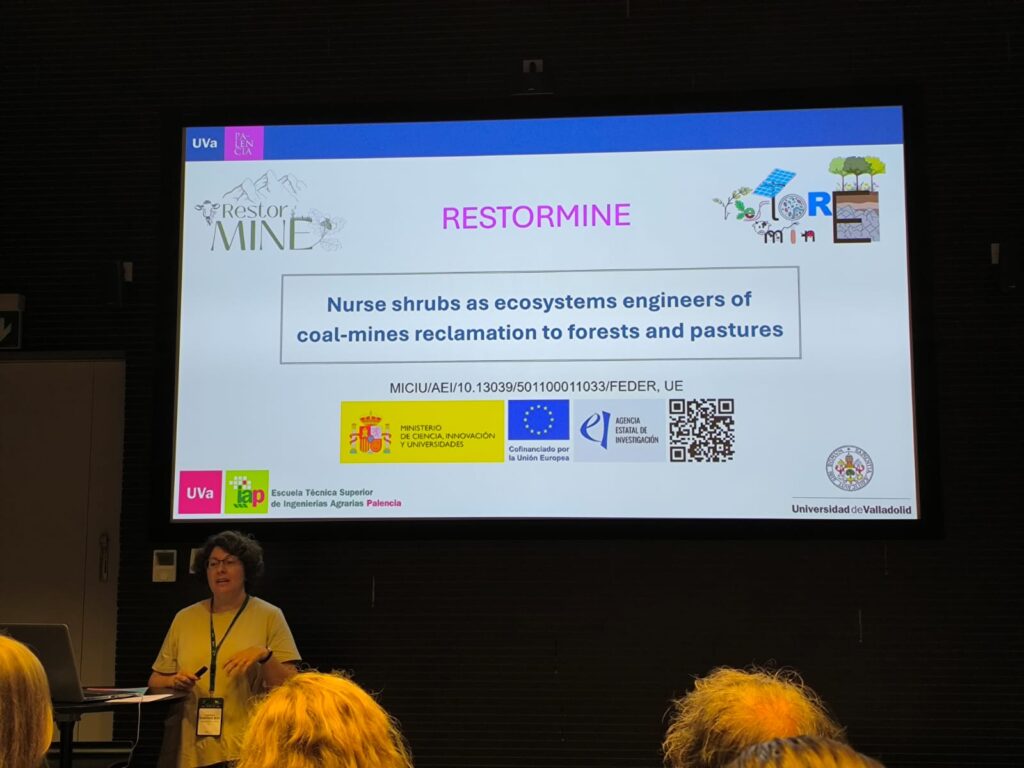
Carolina Martínez-Ruiz at the SERE2024 conference.
Daphne López Marcos, for her part, gave a presentation focusing on vegetation dynamics and changes in soil on the mining slopes of northern Palencia, highlighting how these ecosystems respond to restoration interventions.
The RMC Network’s participation in SERE2024 underlines its commitment to leading mining restoration in Europe. The support of the European Commission strengthens its mission to promote strategic collaborations that contribute to creating a more sustainable future for ecosystems affected by mining.