
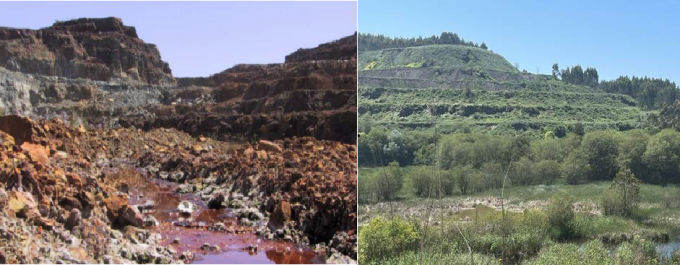
Noelia Castro Fernández, process engineer at TEN, explains how the use of technosols has enabled the regeneration of the former Touro mine (A Coruña)
Carmen Pi
Raising awareness of successful projects is one of the objectives of the Mining and Quarry Restoration Network (RMC): initiatives that demonstrate, on the ground, that another approach to restoration is possible, based on technical knowledge, sustainability and collaboration among sector stakeholders.
In previous articles, we have looked at cases such as the recovery of former mining voids in Los Serranos (Valencia), promoted by VAERSA, or the transformation of the Alba Jerez I quarry into a wetland of high biodiversity value, developed by Holcim. This time, the focus turns to Galicia, to a project that places soil at the heart of the restoration process.
We spoke with Noelia Castro Fernández, process engineer at Tratamientos Ecológicos del Noroeste (TEN), a Network partner, about the restoration of the former Touro mine (A Coruña), a project that began in 2005 and which, twenty-one years later, has become a leading example of mining restoration. The initiative stands out for its use of technosols —soils specifically designed from recovered waste materials—, integrating circular economy principles to restore ecological functionality to a highly degraded environment.
Noelia Castro Fernández, process engineer at Tratamientos Ecológicos del Noroeste (TEN)
- How did the Touro mine restoration project come about, and what environmental problem was it initially intended to address?
The Touro mine restoration project arose in response to the environmental problems generated by the former copper mining operation carried out during the 20th century in the municipality of Touro (A Coruña). Following the cessation of mining activities, large areas of degraded land, waste dumps and exposed mining materials remained, causing environmental pollution processes, particularly related to sulphide oxidation and the generation of acid mine drainage. This process released metals and pollutants into the soil and surface waters, affecting the natural environment.
In this context, a collaboration was established with the University of Santiago de Compostela with the aim of developing a technology capable of regenerating the water surrounding the mine and restoring the ecosystem. In response to this situation, TEN promoted an environmental restoration project based on the use of technosols. The aim was to improve the physical, chemical and biological properties of the degraded land, immobilise pollutants, reduce soil acidity and promote vegetation recovery. Initially, the project sought primarily to address soil and water pollution resulting from former mining activities, stabilising mining waste and restoring the ecological functionality of the affected area.
- The project is based on the use of technosols made from recovered waste materials. What are they?
Technosols are artificial soils created to order to restore degraded land. They are produced by the controlled mixing of different recoverable waste materials that undergo a composting process, with the aim of creating a soil with the appropriate properties for vegetation development. These soils provide organic matter, nutrients and water-retention capacity, while helping to neutralise acidity and immobilise contaminating metals. The main difference compared with other solutions commonly used in mining restoration is that they do not rely on the addition of natural soil, which was unavailable in this case. Instead, previously treated and recovered waste materials are used, making it possible to restore degraded land more sustainably within a circular economy approach.
- What types of waste materials are used to produce these soils, and how is their environmental and health safety ensured?
Technosols are mainly produced from three types of materials: organic materials, liming materials —which make it possible to raise pH— and structural materials, which improve the physical structure of the soil. These waste materials are mixed and subjected to a controlled composting process in which parameters such as temperature, aeration and moisture are monitored, ensuring proper stabilisation. Environmental safety is ensured through prior analytical controls, in compliance with current regulations, and tests that assess parameters such as pH, water-retention capacity and pollutant mobility. In addition, the final material is also tested to ensure that it is stable, safe and suitable for promoting revegetation.
- What changes have been observed in the area since this methodology was applied?
Over these years of work, major changes have been observed in the area. As a result of applying technosols both in open pits and waste dumps, as well as creating reactive wetlands, water quality in the rivers has been restored, raising pH from hyperacid values of 3–3.5 to 6.5–7.5, with no dissolved metals detected. Technosols have made it possible to restore the environmental and productive functions of the soil, enabling vegetation to develop in areas where initially nothing grew. In addition, wildlife has evolved, progressing from extremophile organisms to a complex food web with the presence of insects, birds, amphibians and mammals, together with a significant improvement in the landscape.
- The project is based on a circular economy model. How does this initiative contribute to improving waste management and closing material loops?
In the process of producing technosols, waste materials are properly managed and reintroduced into the production cycle as raw materials. This approach makes it possible to reduce the amount of waste sent for disposal, optimise the use of resources and avoid extracting large volumes of natural soil for restoration work.
- The Government recently approved the first 2026–2030 Action Plan for the Sustainable Management of Mineral Raw Materials. Based on your experience, what role do initiatives of this kind play?
We believe that initiatives of this kind represent an important step towards integrating sustainability and environmental restoration more effectively into mining activities. They strengthen the circular economy approach and establish more demanding environmental standards. We believe it is essential to incorporate restoration as an integral part of mining activities, rather than treating it solely as a final stage following the closure of a mine.
- In a context of growing demand for raw materials, what role should mining restoration play?
Mining restoration should play a central role in ensuring that the development of the sector is compatible with the protection of the environment and the territory. It should therefore be integrated from the initial planning stages, making it possible to minimise impacts from the outset and facilitate faster and more effective recovery of affected areas.
- What lessons can this project offer to other mining restoration projects or future mining operations?
The Touro project demonstrates that the use of technosols can improve the physical, chemical and biological conditions of soils that have been severely altered by mining activities. It provides a sustainable approach based on the circular economy and generates technical knowledge that can be applied in other similar contexts.