
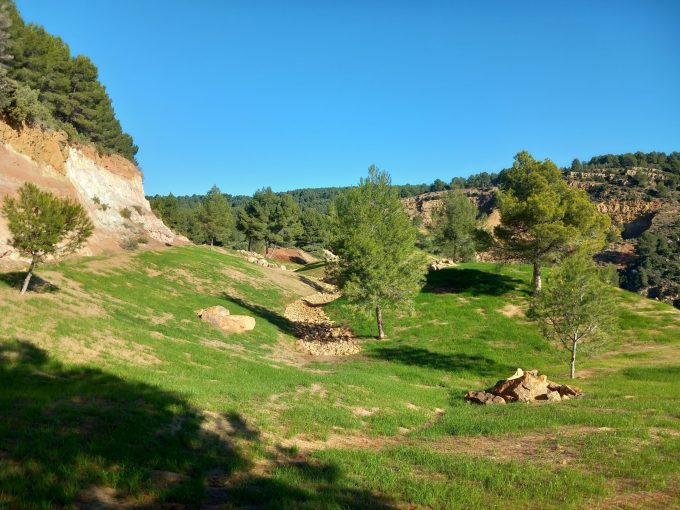
The intervention, funded with European funds, is being led by the Generalitat Valenciana with an ecological approach adapted to the Mediterranean environment
Carmen Pi
The Generalitat Valenciana, through the Directorate-General for the Natural and Animal Environment and its Forest Planning and Management Service, is promoting an ecological restoration project at several sites in the Los Serranos area (Valencia), focused on the recovery of land degraded by former mining operations. The intervention applies an innovative approach adapted to the Mediterranean environment.
This public project continues the work initiated through the European LIFE TECMINE project, also led by the Generalitat Valenciana and co-financed by the LIFE Programme of the European Union. This initiative was designed to test pioneering approaches to mining restoration in Mediterranean environments. Internationally recognised —including through the LIFE Citizens’ Prize 2023—, LIFE TECMINE was presented as a successful example at forums such as the UN Biodiversity Conference (COP15) and the United Nations Convention to Combat Desertification (UNCCD). “The LIFE TECMINE project laid the foundations for the creation of the Mining and Quarry Restoration Network,” recalls Beatriz Olmo Gilabert, the Network’s technical director.
Olmo also highlights that the new project promoted by the Generalitat Valenciana represents an intervention aligned with the objectives of the RMC Network: “It is an example of modern, rigorous and replicable mining restoration. At the Network, we want to highlight it as a benchmark model that demonstrates the key role public administrations can play in transforming the sector.”
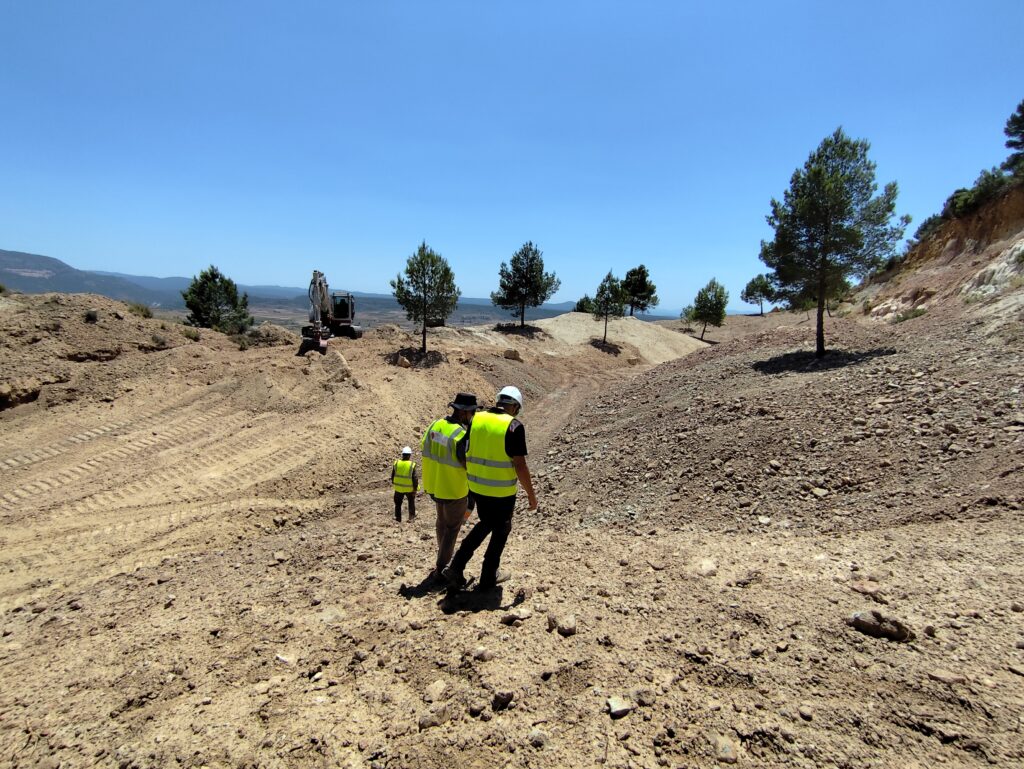
La Lámpara mining void during the works, in the first earthmoving phase.
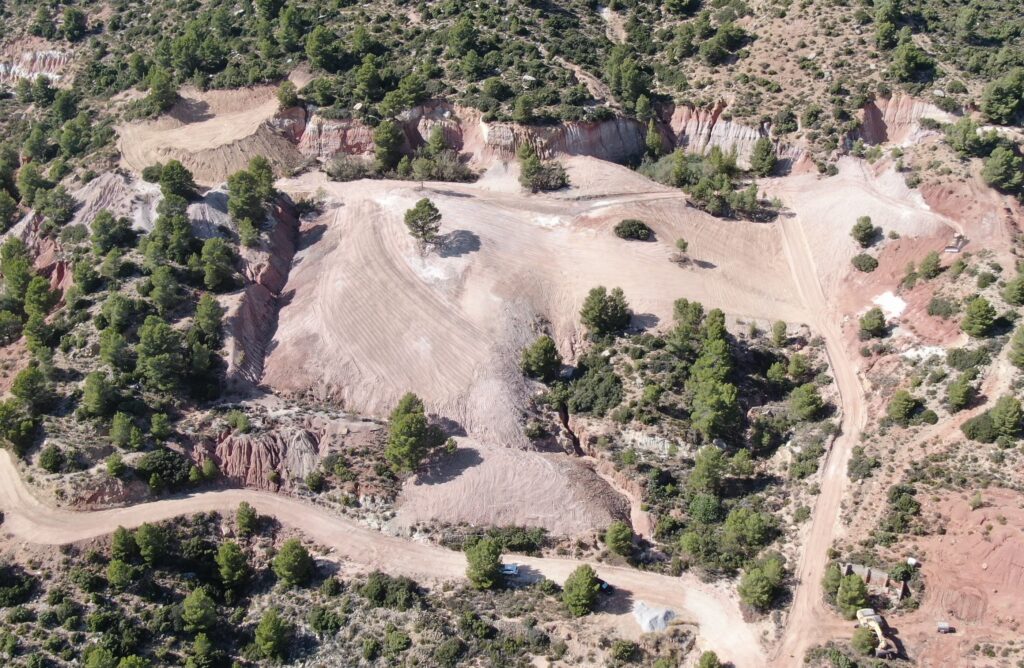
The project, funded with European funds from the Recovery and Resilience Facility (RRF), forms part of the Spanish Government’s Recovery, Transformation and Resilience Plan, linked to the Next Generation EU funds. The intervention focuses on 14 former mining voids located in public forests. The sites, which were active between the 1950s and 1970s, were left unrestored because they had been developed before the 1982 national legislation requiring environmental restoration following the closure of a mine came into force.
“These are expired mining rights that no longer have a legally responsible party and which have generated environmental and landscape impacts for decades. The opportunity to act has come with RRF funding,” explains Ana Isabel Aparicio Navarro, a forestry engineer and technician at VAERSA, the public company responsible for providing technical assistance and supervising the project. According to her, the intervention areas cover a total of just over 57 hectares and have been divided into two phases. The projects were drafted at the end of 2022 and implementation began in summer 2025.
Several specialised organisations that are Network partners are also involved in the project, both during the design and implementation phases. The companies Natura Constructiva and REVI are responsible for carrying out the field works at the different sites, while the Geomorphological Restoration team at the Complutense University of Madrid (UCM) designed the terrain modelling and is responsible for on-site monitoring and technical training for machinery operators.
The works follow an approach similar to that developed in the European LIFE TECMINE project, drawing on its lessons learned and methodologies. The main actions include geomorphological remodelling of the terrain, soil improvement and revegetation with native species. This combination of techniques has enabled appropriate water management and a more stable landform, better integrated into the landscape. “The design aims to restore ecological functionality to these areas. If the soil is not suitable, vegetation cannot establish itself. And without vegetation, the soil is lost. It is a delicate balance that we are managing to restore,” Aparicio summarises.

The restoration also includes bioengineering measures in areas with steep slopes and the use of local materials such as colluvium and organic amendments to improve soil quality. At one of the sites, a small interpretive trail has also been planned to highlight the area’s geological and mining heritage.
The implementation phase is well advanced: at the most complex sites, terrain remodelling and soil preparation have been completed, with only planting remaining. “Overall, we could say that the project is at an advanced stage, with 60–70% of the works completed,” the technician indicates.
Monitoring will be carried out by the Mediterranean Environmental Studies Centre (CEAM), a Network partner. In addition, VAERSA is working with the European Commission’s advisory service, Green Assist, on the design of quality indicators to assess results over the medium and long term, as well as on protocols for applying this knowledge to future restoration projects. “We have realised that there is a lack of references on how to build functional soils in mining environments. That is why we want to use this experience to learn and generate knowledge,” she adds.
Aparicio stresses that restoration should be planned from the outset in any mining project, not only for environmental reasons but also for economic ones. “When it is integrated from the beginning, restoration is cheaper. Reactive solutions, years later, involve higher costs and are less effective,” she explains. Nevertheless, she warns that in many cases, although restoration is included in the initial documents, it is then not properly implemented or genuinely monitored. “The administration approves many projects that include restoration on paper, but which are not implemented in practice. And without monitoring, there is no guarantee that restoration will be carried out properly. Restoration can no longer be treated as something secondary: it must form part of the mine’s design from the very beginning,” she stresses.
VAERSA highlights the value of this project as a pilot experience for sharing applied techniques, lessons learned and also the challenges posed by mining restoration in Mediterranean contexts. “We want this intervention to demonstrate what works, generate useful knowledge and transfer it to future restoration projects,” Aparicio concludes.